Argentina Lost the Final on Sunday. I Keep Thinking About the Seven Games Before It.
Argentina reached back-to-back World Cup finals on a run of one-goal wins. What that climb teaches small business owners about effort, ceilings, and building something that compounds.

Spain won 1-0. Ferran Torres scored in the 106th minute, and that was the tournament.
I'm Argentine. I watched the final the way most of my family watched it, which is badly, from behind a hand, not saying anything useful to anyone in the room. Then it was over and my phone filled up with the same three messages from cousins in Buenos Aires and friends here in The Woodlands.
I've had a day to sit with it. What I keep coming back to isn't the scoreline.
The climb was harder than the ending
Argentina got to that final through seven matches. They won the group cleanly, beating Algeria 3-0, Austria 2-0, and Jordan 3-1. Then the knockouts started and everything got tight.
Cape Verde took them to extra time before Argentina won 3-2. Egypt lost 3-2. Switzerland went to extra time and lost 3-1. England went out 2-1 in the semifinal.
Four one-goal games in the last five. Two of them needed extra time. Nobody steamrolled anybody. Argentina kept finding a way for a month straight, in a competition that had already handed them the trophy four years earlier and would have been perfectly happy to see them go out in the round of 32.
Reaching consecutive World Cup finals puts you in a very short list of countries. Argentina did it, and yesterday it ended with two shots on goal against a Spain side that was better on the day. Both of those things are true, and the second one doesn't erase the first.
You've probably run a season like that
Here's why I'm writing about this on a business blog.
Most owners I sit down with have been grinding out one-goal wins for years. You landed the client that almost went to the competitor. You made payroll the month the big invoice paid late. You covered for the ops person who quit in March and never really got replaced. You answered the 8:47pm call because nobody else was going to.
None of it looks like dominance from the inside. It looks like showing up again. And it works, genuinely, for a long time.
I ran Outcome Orbit that way for a while too. Outcome Orbit is me. One person, no employees, which means I didn't have to wonder where the bottleneck was. Every proposal came through me, every follow-up waited on me, the meeting recaps sat in a folder until I found a Sunday, and the pipeline got looked at whenever I surfaced long enough to look at it.
I'd spent close to thirty years building systems inside enterprises, at Dell and at Google Cloud, and I was still running my own company out of my head and my calendar.
Effort has a ceiling, and it's usually not where you think
The thing about winning on effort is that it holds right up until the moment it doesn't.
Argentina spent the tournament living on narrow margins and a goalkeeper playing the best football of his life. Emiliano Martínez kept that final at 0-0 for 105 minutes against a team generating 2.29 expected goals. He was outstanding. He was also the reason the scoreline stayed close, which is a different thing from the team controlling the game.
Businesses hit the same wall. The owner who's the best salesperson, the final approver, and the institutional memory is running a company that performs exactly as well as they do on any given Tuesday. Nobody in that position stalls out from lack of effort. They stall out because there's nowhere left to put more hours.
Getting past that means building something that keeps improving while you sleep, and then not having to rebuild it every quarter.
What compounding actually looks like on a small business P&L
Let me put real numbers on this, because "build systems" is the kind of advice that sounds good and pays nothing.
A part-time admin in this market runs $2,000 to $2,500 a month. That person handles inbox triage, meeting notes, proposal drafts, follow-up sequences, CRM hygiene, the pile of small things that fall through when the owner is on a job site.
An agentic setup that covers a meaningful slice of that work runs $500 to $750 a month once it's built. Call the delta $1,250 to $2,000 monthly. On a $5,000 setup, that's roughly a two-to-four month payback, and then it compounds, because the thing gets more useful every week instead of less.
That last part matters more than the savings. A system you keep sharpening is worth more in month twelve than it was in month one, which is not how any other line on your P&L behaves.
Where this fits
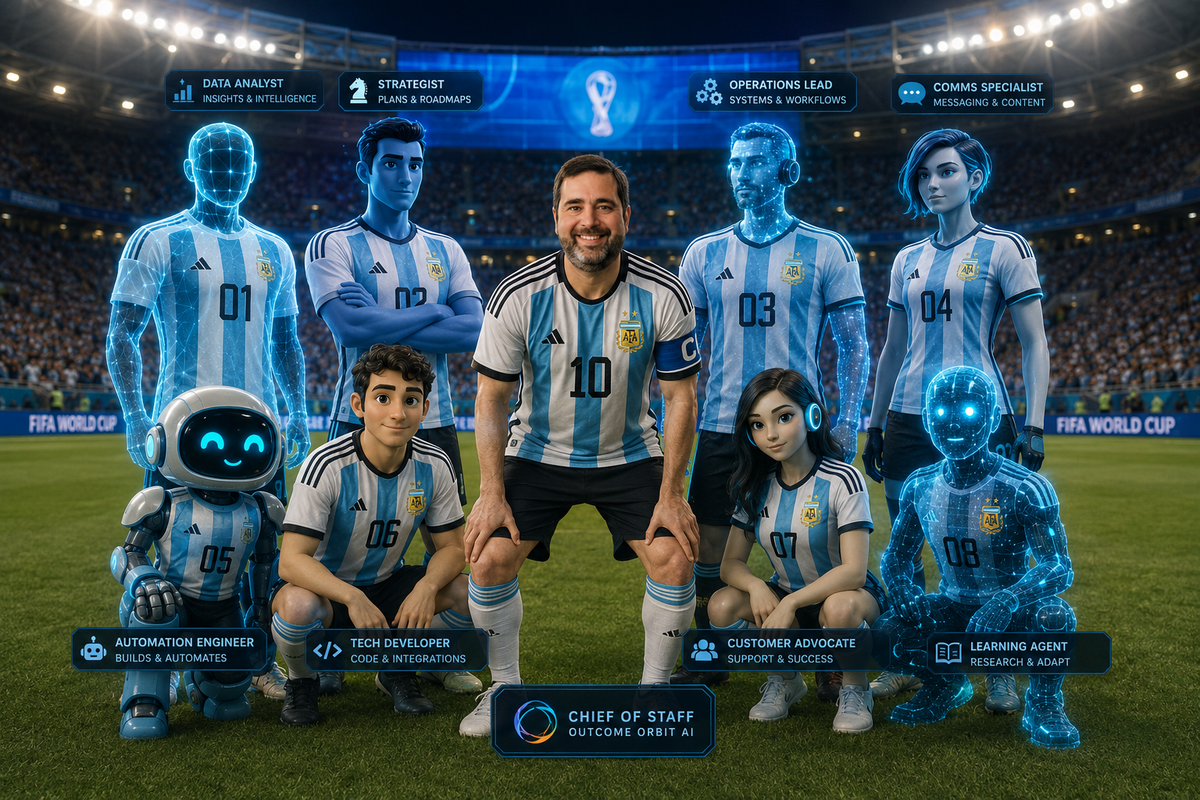
That's the reason Orbit OS exists, and it's why I built it on my own company first before selling it to anyone.
It's an operating layer that holds your business context, brand voice, clients, offers, SOPs, and runs specific functions on a schedule. It uses the tools you already pay for. A maintenance pass runs weekly, looks at what the system did, and proposes improvements you approve or reject. The pain it solves is narrow and specific: you are the bottleneck, and every quarter you stay the bottleneck is a quarter the business can only grow as fast as your calendar.
It's not a chatbot, and it isn't a ChatGPT subscription with better instructions. Three weeks to build, then it runs.
I'll be honest about the state of things: I've built this for my own company and I've done custom versions of it for clients in marine, insurance, and healthcare. The productized version is new, and I'm being selective about the first few. If you want to see what my own accumulated business context looks like when it's actually running, I'll show you the real thing rather than a demo environment.
Two ways to go from here
Argentina will be back. The climb starts again in qualifying, the way it always does.
Your version starts a lot sooner than that.
If you want to talk through where you're the bottleneck and whether any of this applies, book a 30-minute call at outcomeorbit.ai. No deck, no pitch, and I'll tell you if the answer is "not yet."
If you'd rather see it before you talk to anyone, the workshop is the low-commitment version. Ninety minutes, you leave with a working AI chief of staff you built yourself, and you'll know within the first twenty minutes whether this is real or not.
Vamos, Argentina. See you in 2030.
Mike Totah is the founder of Outcome Orbit AI in The Woodlands, Texas, where he builds practical AI systems for small and mid-sized businesses. Nearly thirty years in technology, including time at Dell and Google Cloud. Growth, Automated.