I've Run This AI Workshop Twice. Here's What Actually Happens in the Room.
Two cohorts in, here's what small business owners actually build in 90 minutes, what I got wrong the first time, and what I changed.


I've run "Build Your AI Chief of Staff" twice now, both times at the Woodlands Chamber. I'm running it a third time on September 23.
Rather than tell you how great it is, I'd rather tell you what actually happens in those 90 minutes, including the part I got wrong the first time. If you're deciding whether it's worth a morning and $499, that's more useful than adjectives.
The first one was too short
I built the first version as a 60-minute session. That was a mistake, and I knew it about 35 minutes in.
Here's the problem. The whole point is that you build the thing yourself, live, on your own business. Building means typing. Typing means the room moves at the speed of the slowest laptop, which is exactly how it should be. But 60 minutes doesn't leave room for that. I ended up pushing two of the layers into homework and running one demo instead of three.
Homework is where good intentions go to die. If you leave the room without having built it, you're not going to build it Thursday night.
So the second version runs 90 minutes, and the extra half hour goes almost entirely to build time. That's the single biggest change between round one and round two.
The thing nobody warns you about: everyone's on a different tool
In the first session, most of the room was on Claude and one person was on GPT-5. Reasonable. They're both good. But the setup steps aren't identical, and I lost live minutes walking one person down a different path while everyone else waited.
Now there's a question on the registration form asking which tool you use, and a setup email that goes out ahead of time. Every registrant can also book a 30-minute call before the workshop to get installed, so the room starts with everyone at the same place. Nobody spends the first twenty minutes downloading something.
Small operational fix. Big difference to how the session feels.
What you actually build
The session is built around a simple idea: your AI is useless to you until it knows your business, and by default it forgets everything the moment you close the tab.
So we build the memory first.
You write an identity file, which is how you work, what you're good at, what you want handled without being asked. Then a business context file, which is what your company does, who your customer is, what you sell, how you talk. These are plain text files. Nothing proprietary, nothing you can't take with you.
Then you build a skill. A skill isn't a prompt. It's a narrow, repeatable unit of work with the steps written down, so you're not re-explaining the job every time. The one everyone builds is a daily brief, and by the end of the session it runs on your actual calendar and your actual commitments.
Then, in the last stretch, you draft a second skill of your own choosing. That's the part I care most about, because it's the difference between having a thing I gave you and understanding how to make more of them.
You leave with an 8-item Starter Kit: the two foundation templates, three working skills, a 10-prompt pack, a checklist for connecting your AI to other systems safely, and a 30-day roadmap. All of it yours, no license, nothing to renew.
The demos run on my actual business
Every demo in the room runs on my real data. My calendar. My open commitments. My pipeline.
That's not a flex, it's a constraint I put on myself, because vendor demos running on vendor data are the reason most owners have stopped believing any of this. When I show you the commitment tracker, it's pulling my real commitments, including the ones I'm behind on. When I show the meeting prep skill, we run it live against the workshop we're currently sitting in. I wrote about the meeting recap problem a while back, and that skill is the answer to it.
If it breaks in the room, you see it break. That's happened. It's fine. You learn more from that than from a rehearsed screenshot.
What people said afterward
Two people from the first two rooms left public reviews, so I'll let them talk instead of me.
Devin Hedgepeth, who runs Floor Coverings International of The Woodlands, wrote: "I attended one of Mike's workshops and it was extremely informative. His approach to helping you understand and construct your own AI chief of staff agent is super helpful! I am excited to see what the power of this technology can do for my business"
Daniel Gonzalez of Ascend Management Consulting wrote: "Mike is very profesional and has an advanced knowledge on the use of AI. He is a great source of knowledge for those like me that want to stay ahead in technology."
Both of those are on our Google profile if you want to read them in full.
Who should skip this
Genuinely, some people should not come.
If you've never used ChatGPT or Claude at all, this isn't the right first step. The session builds on a working baseline, and you'd spend the whole time catching up. Start by using one of them for a couple of weeks on ordinary tasks, then come to the next cohort.
If you want someone to build it for you rather than build it yourself, the workshop is the wrong door. That's a different conversation, and I laid out the economics of it in an earlier post about what a $500-a-month hire looks like.
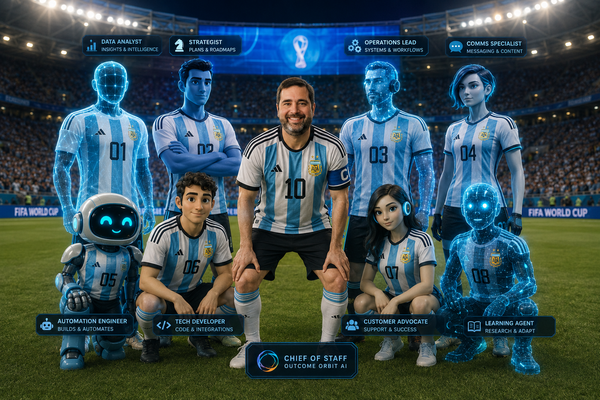
And if you're expecting to walk out with a finished system, adjust that. You walk out with a working foundation and a map. The compounding happens over the next month, which is the honest version of how this goes. I wrote something after the World Cup final about how the seven games before the last one are the ones that matter, and that's more or less my whole feeling about building these systems.
The next one
Wednesday, September 23, 9:00 AM, Woodlands Chamber of Commerce. Ninety minutes. Twelve seats, because past twelve I can't actually help anyone. $499.
Bring a charged laptop, there are no outlets at the seats, and one paragraph about your business.
And if you read all this and thought "that's interesting but not for me right now," that's a completely fine outcome. Reply and tell me what would make it useful, and I'll factor it into round four.
Mike Totah is the founder of Outcome Orbit AI in The Woodlands, Texas, where he builds practical AI systems for small and mid-sized businesses. Nearly thirty years in technology, including time at Dell and Google Cloud. Growth, Automated.